Your guide to starting Krav Maga in Bristol in 2025.
INTRODUCTION
If you’re searching for Krav Maga in Bristol, you’ve landed in just the right place. We’ve opened our doors to new members with our 2025 Foundation, a 4 week program in Krav Maga basics, suitable for absolute beginners. Read on for details.
WHAT IS KRAV MAGA?
In the leadup to the Second World War, Bratislavan Jew, Imi Lichtenfeld, created Krav Maga as a means for everyday people to defend themselves against horrendous violence. Imi realised what most martial arts even today forgets, that real-world violence is fast, lethal, and heavily dependent upon psychology, not raw technique. Krav Maga focusses on developing a small set of instinctive movements and flinch reactions alongside a program of psychological conditioning to help practitioners develop resilience in the face of fear and violent assault.
So successful has Krav Maga become that it is now the most widely used system of hand to hand combat in the professional world today. It is standard syllabus in a vast array of military and law enforcement agencies worldwide. Its success is due both to its effectiveness not only physically, but psychologically as well. Practitioners of Krav Maga, who vary widely, all share one thing: The iron will to fight.
You may not think you have it in you, but you do. You just need to be taught to find it!
WHAT MAKES KRAV MAGA DIFFERENT?
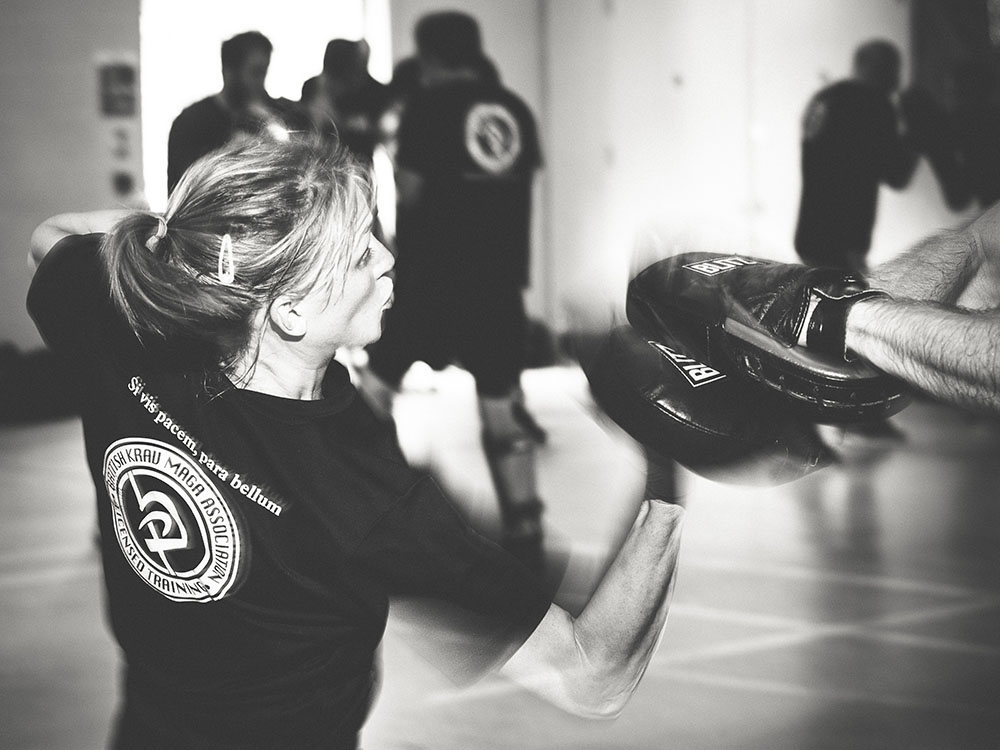
No rituals, no belts, no bowing. We train in everyday clothing and shoes, focussed on realism and real-life situations.
We train in sports halls, but also occasionally in stairwells, corridors, and even cars.
There isn’t an endlessly complex syllabus. Just a limited number of highly effective techniques chosen for their simplicity and ease of learning.
While most Krav Maga practitioners choose to continue training to keep their sharpness, it doesn’t take years to become an effective self-defence weapon. Competence with dedication can come in just a few months.
Heavy focus on the psychology of combat – we don’t just pay lip service to fear, we train to innoculate against it. As Instructor, Will James’ research shows, technique doesn’t matter if you’re frozen in fear. We have a series of proven teaching techniques to safely and progressively build confidence and resilience in students.
WHY LEARN KRAV MAGA IN BRISTOL?
Bristol is an amazing city, but like any city it comes with challenges.
Busy nightlife areas like Clifton, Harbourside, and the City Centre are seeing a sharp rise in violent offences.
Knife crime is up nationally, especially in youth communities. over 25% of all recorded knife offences are committed by under 16s.
Student populations in Bristol University and University of the West of England attract predatory behaviour from the criminal underclass, especially in the nightlife areas listed above.
Training in Krav Maga is statistically proven to reduce your likelihood of being selected as a victim, just as a function of gait – how you carry yourself as a person who trains.
Awareness skills mean the capacity to detect threat long before it reaches you.
A solid understanding of the law around self-defence enables you to act with moral and legal confidence when your life and the lives of your family depend upon your actions.
WHAT TO EXPECT AT KRAV MAGA NORTH BRISTOL
When you join our Bristol Krav Maga sessions, you’ll be met by your instructor, Will, who will select and pair you with a mentor. Your mentor will be an experienced student or assistant instructor who will work with you over your 4 week foundation to ingrain the necessary skills, safety, and knowledge for you to properly and successfully begin your Krav Maga journey.
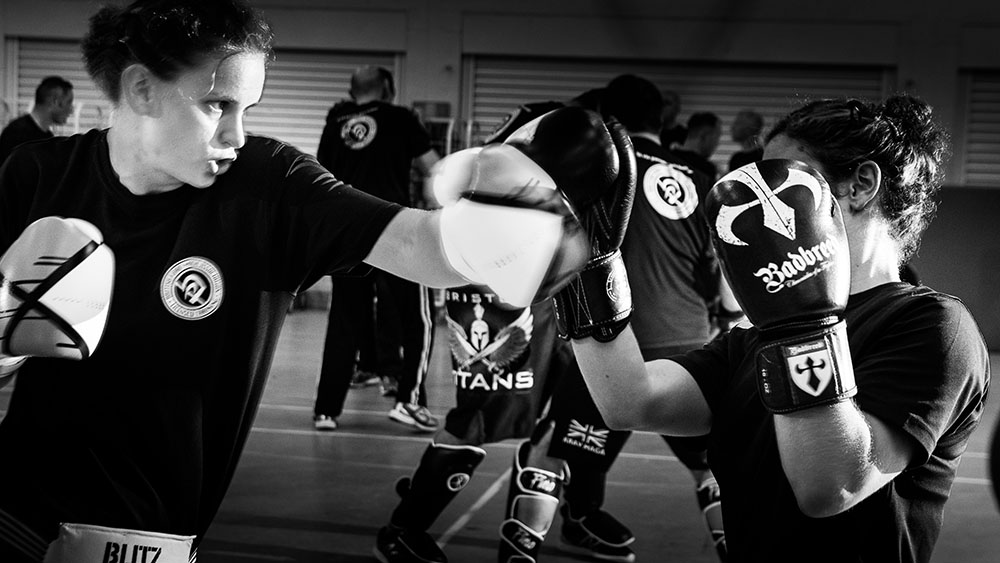
This isn’t just a business to us. We are a friendship group as well as a training group. To the last man and woman we all respect and enjoy each other’s company. For that reason, we restrict membership. You can expect and depend upon small classes, personal instructor attention, and a good learning curve.
WHAT DO I WEAR / BRING?
When you come along to your beginner session with us in North Bristol, you should wear any comfortable clothing and trainers. We recommend against wearing shorts, and instead recommend leggings, joggers, anything that covers the knee. We often use knees for striking, so clothing protects the skin.
Also bring a bottle of water, as any Krav Maga class is good exercise. If you’re prone to low blood sugar when you exercise, you should also bring a banana, nuts, or any rapidly absorbed calorie source, but we recommend not eating directly before a session.
DO I NEED TO BE FIT?
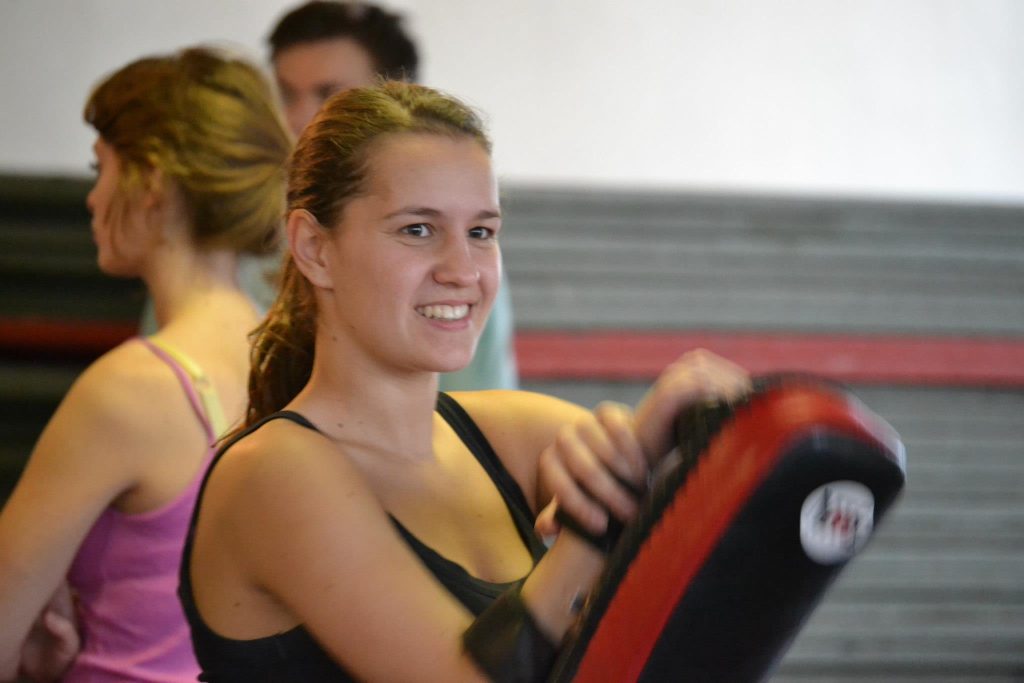
You’ll get fit training with us, but you don’t need to be fit to start. There is no pressure in our sessions – until you want it, that is. In the beginning you are in control of how hard and for how long you train. No judgment, no bullshit, just support and instruction.
Waiting to be fit before training is silly. Fitness is one of the side benefits of Krav Maga training. Most of our members are combat fit, but they didn’t arrive that way. We’ve seen amazing transformations over just a few months of training.
HOW DO I START?
To secure one of the just 15 spaces between now and the end of November, please message or call on 07866417618, or use the contact form below.
From Lawful Survival by Krav Maga North Bristol instructor, Will James. This excerpt, from the introduction to Lawful Survival, discusses the problem with bravado in the martial arts and self defence world. Whether you live in Bristol or anywhere else in the UK, you will have encountered such attitudes to self-protection, and it is essential that you learn to see through bravado to the ugly truth beyond.
If you prefer audio, here is a reading of this chapter:
“The bitterest creature under heaven is the wife who discovers that her husband’s bravery is only bravado, that his strength is only a uniform, that his power is but a gun in the hands of a fool.” – Pearl S. Buck 1892 – 1973
Our first job is to challenge assumptions. Facing fear means facing the facts of the situation, unguarded, unprotected, and unadulterated. In the theatre of real-world violence, illusion has no place.
Neither does bravado.
Yet in bars across Bristol, and in training halls and gyms, there are people talking about self-protection as if it were commonplace, easy, everyday. Uninformed by research or experience, casual bravado underpins conversations that vary little in meaning and substance. What would you do if someone broke into your home? Would you care about the law? Do you leave a weapon by the door, by the bed? Would you use it? What would you do if someone pulled a knife on you while you were out jogging? Demanded the phone and those new Beats headphones? The key to the new Discovery? The pin number for your AMEX?
What if the next domestic call you attend while on duty involves an offender with a knife opening the door and trying to kill you? Would you handle it? Would you put them down?
You know the conversation. If you haven’t had it, maybe you’ve heard it. “God help anyone who comes into my house. I keep my old cricket bat by the door. I have a crowbar by my bed. I keep a Maglite in the car — the heavy kind with four D cells. I’d hit them with that. I don’t care what the police say, if someone comes into my house I’m going to do them with my torch.”
This overconfidence isn’t limited to civilians, either. Even in the world of the violence professional — police, military, security — there can and does exist a culture of complacency around violence. When you knock on five doors a day, six days in a set, and for months or years nothing bad happens to you, you inevitably tend towards complacency, towards the unconscious belief that you don’t need to worry, that you can handle whatever happens. Complacency breeds false confidence, a confidence untested by exposure to real threat.
Civilian or professional, complacency comes from rolling the dice and getting lucky for too long, from making the mistake of thinking that because you’re okay now and have been okay in the past that you always will be okay. This error in thinking is called Survivorship Bias, and it’s very common.
Complacency rapidly breeds confidence. To listen to people talk about violence it is easy to think that self-protection is as simple as picking up a bat or a torch and swinging it at an intruder or a mugger. To a police officer it may seem as easy as grabbing hold of an arm and putting someone on the floor like it was the simplest thing in the world to do that. Unfortunately this simplicity of thinking doesn’t take into account the unpredictability of real world violence, nor the deterioration of cognition and skill that occurs in the face of such threat.
There is a place called violence. Most don’t know it. It is a lonely and terrible country, torn apart by war. The people you find there are monsters, predators, everything that an average person, in the bubble of civility, would call evil. How many times has an average person been to that place? Honestly? And we’re not talking about school-yard scuffles or two drunken friends sticking their neck out at a party and shoving each other. We’re talking about being attacked by a wild animal and having to fight, literally, for your life.
Most civilians in our culture have never been to that place. A good percentage of police have, and yet in the force, complacency is still commonplace.
If violence has happened to you, if you have been there to that country, bravado will have deserted you. The people who know that place are typically silent on its nature. Silent and humble. And those who have been there, how many times have they been there? Once? Twice? How long each time? Most assaults are decided in seconds. So their experience, across a lifetime, likely totals just a few seconds. Does that make them experts? Travel guides to that country’s horrors?
No.
For civilians, or police officers in initial training, reading this, try to imagine a person.
He is in his early twenties, but looks a decade older because of the brown he’s been putting in his arms for the last dozen years. He’s malnourished, his body fucked up on years of opiate abuse, on the cycle of constipation and laxatives, on junk food and chain-smoking, his teeth falling out and his nose bent and corroded from his forays into stimulants — amphetamines, adderall and cocaine. The moment he comes through your door, in the dead of night, he’s been off the smack for a day and a half. He’s in a fever of pain, fear, nausea, cramping and worse. He knows that his hunger will deepen by the hour, until it incapacitates him, until he no longer has the ability to do what he’s doing right now to solve his problem. He needs his solution more than you have ever needed anything. He knows desperation like you never have and never will. He is coming into your house to take something, something he can sell for a fraction of its value to fund a solution that will last him a few hours at best. And he will literally kill to do it.
Still not with me?
There is nothing this human will not do to get what he needs. Absolutely nothing. If you don’t stand in his way, he will take and run. If you stand in his way, he will stab you or punch you to the floor, and he will take and run. If you go at him with a weapon, and you’d be the hundredth person to try, he will take it off you and beat you to death with it to make sure you don’t pose a threat to him, then he will take and run.
Your morality, your frame for looking at the world, he doesn’t have that. It’s gone, along with any notions of guilt, remorse, conscience, or self-respect. Years of addiction have drummed all that out of him.
But don’t think that his addiction makes him weak. He’s a strong kid, stronger than you can ever know, driven to the solace of the drug by a life of terrible violence and abuse.
When you were taking your first steps, he was sitting in a crack-house full of addicts, starving and undernourished. When you were going to nursery, he was stealing food and getting beaten when he was caught, learning how to take a beating with the minimum of serious damage, desensitising to the pain and the fear. When your parents came home from work and cooked you dinner, his sent him out to run money and drugs, or came home loaded and beat him until his eyes swelled shut and his gums bled. When you were doing your entrance exam for secondary school, he was out in the parks fighting other kids over selling territory, knowing that if he lost he’d lose more than territory, that he’d take it badly at home, that he might not get to eat. While you were mastering maths, English, maybe even a language, he was mastering violence, learning through the weekly, if not daily fights and beatings how to most effectively beat another human to the ground and into submission. While you were learning the ropes in your first job he was learning how to use surprise and the threat of a weapon to paralyse a victim so that he could take what he needed with the least risk to him, and in the least time. By the time you were competent in your career, he was a master of his, the veteran of a thousand or more assaults, beatings, stabbings, muggings, burglaries, deals and arrests.
You may have had a fight once, maybe you even won. But the threat he will bring to your door won’t be a fight. He doesn’t want to fight. He wants to beat you and take. This isn’t a boxing ring, or a dominance game in a bar, this is violence. And he has experienced immediate violence almost every day of his life. No solace. No saviour. No police to call when it all became too much. He’s lost count of the times he’s struck someone, knocked them down, stabbed them when he was too weak to fight any other way. And he’s lost count of the times he’s been the victim of the same. The violence, it holds no deep fear for him like it does for you. And in that lack of fear, in that almost total desensitisation, there is a certainty. Not certainty that he will win, because truly he doesn’t care about win or lose in the way that you do, but certainty that he will fight. Certainty that he will do everything that is necessary to get the job done and come home with his solution. While you are finding your feet, recovering from the shock of the break-in or mugging, he has already beaten you. You’re the hundredth person to swing a Maglite at him. The hundredth person to leave a cricket bat by the door for him to arm himself with when he comes into your house.
And when he comes he will come without hesitation. At the moment you become aware of him, he’s already had hours to come to terms with what’s about to happen. He has momentum, practice, initiative.
All you have is surprise, shock, fear.
Your surprise. Your shock. Your fear.
Think about this.
Carefully.
That land we were talking about, that country of violence, at best you are a visitor. He’s a native.
Bravado has absolutely no place in this fight. Because, when it happens, it won’t be a fight. It will be an assault, and if you are arrogant, unprepared, you have little chance of coming out the other side. In what other arena would you, as an absolutely untrained, inexperienced amateur, expect to overcome a lifetime professional in a game where the stakes are your lives? Would you take on Mike Tyson in the dead of night, ten million quid against your life and your family’s lives when you’ve never as much as thrown a punch before? What about going three sets with Federer with the same stakes, when you’ve never so much as picked up a racket?
And yet, the world over, there are people in bars with little to no training or experience talking about the arena of violence as if they have dominion over it, and over those who live there, those who carry out assault as a livelihood and as a way of life. Have you heard such talk? Do you see the error in it?
Time and time again, the statistics tell us that there are only two significant predictors of success in the survival of real world violence. The first, overwhelmingly, is exposure to previous instances of real-world violence.
The second, self-defence training that involves close approximation of real-world violence through stress inoculation, contact drills and adrenalisation.
In today’s world, the vast majority of people have neither experience nor relevant training and, predictably, fail when victimised by the violent, freezing up and suffering injury or death. To survive violent assault, a victim must come to the assault not with bravado but with realism and humility. You have to see that to run is not shameful. You have to realise that to die or kill defending property is hubris. You have to understand the difference between defending your life and defending your ego. You fight when there is no other choice, when you’re on the stairs and you meet that man from that terrible country and it’s clear there is no other way. And on that night, make sure it isn’t a fight. Train until you are the master of your fear. Train and find a way to surprise. Hit first. Hit hard, with so much aggression that you overwhelm your attacker. Train for that moment with the real-world firmly at the front of your mind.
A violent assault is not a competition decided by technique. It’s an existential struggle decided by will and fear and conviction.
Once the dual arsenal of aggression and violence are deployed, technique is an afterthought.